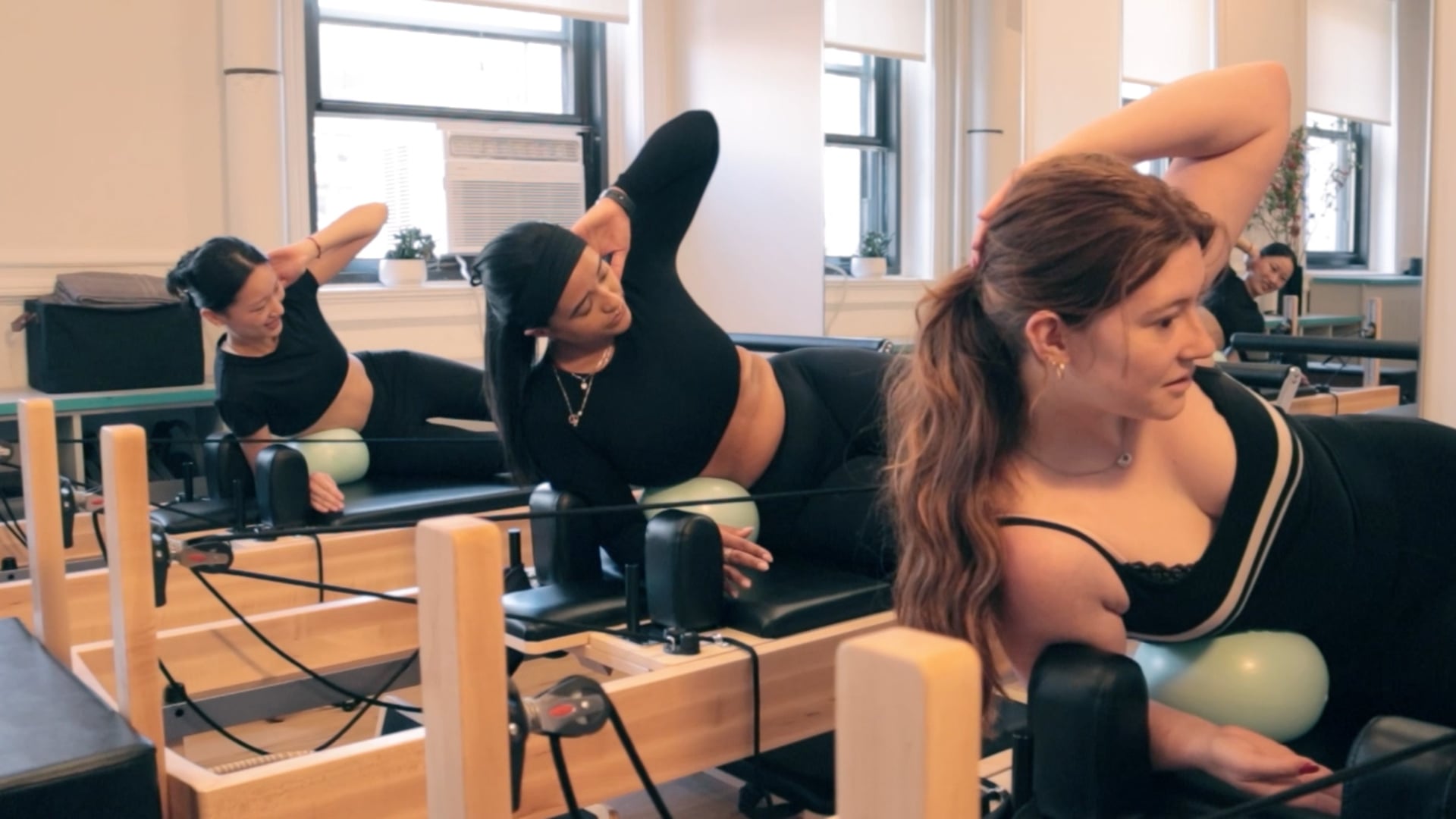

5 min readEnhancewell
Why do you practice Pilates?
Flexibility? Core strength? Stress reduction?
For those navigating hormonal shifts, Pilates does all that — and more.
Dana Chau, our Studio Manager and Pilates Lead, is a certified Menopause Specialist through Girls Gone Strong. She’s 54 and 8 years post-hysterectomy — combining education with lived experience.
Let’s talk about how Pilates supports you through this transition.
Pilates Is Good for Periods — and Beyond
As your body moves into perimenopause and menopause, estrogen levels fluctuate and eventually decline. With this shift often comes:
- Increased joint stiffness
- Heightened pain sensitivity
- Longer recovery times
- Changes in body composition, including increased abdominal fat
- Disrupted sleep, which makes everything above feel worse
Estrogen plays a quiet role in keeping connective tissue supple and recovery brisk. When it drops, the same workout that used to leave you energized can leave you achy for days. That isn’t a sign to stop moving — it’s a sign to move differently.
Why Training Harder Often Backfires
Many women respond by training harder — more HIIT, more boot camps, more intensity. But how you trained at 35 isn’t necessarily how you should train at 50.
High-intensity workouts are not the enemy. They support cardiovascular health and bone density. But when layered onto chronic stress and poor sleep, excessive intensity can impair recovery and elevate cortisol — the exact hormone already working against your midsection.
The result is a frustrating loop: train hard, sleep badly, recover slowly, train hard again. Breaking that loop doesn’t mean giving up intensity forever. It means earning it back on a foundation that can actually absorb it.
(Peri)menopause Isn’t About Training Harder
It’s about training smarter.
When programmed appropriately, Pilates builds exactly what the menopause transition threatens most:
Neuromuscular coordination
Balance and proprioception decline with age — and falls become a genuine health risk. Pilates trains the conversation between brain and muscle on every rep, keeping reaction time and stability sharp.
Bone health through resistance and load
Estrogen loss accelerates bone-density decline. The spring resistance of the reformer and tower loads bones and muscles without pounding joints, which matters when stiffness and sensitivity are already up.
Breath-to-pelvic-floor coordination
Coordinated breathing with deep core and pelvic-floor engagement helps reduce those “oops” moments that become more common as estrogen drops — and it doubles as a down-regulation tool for a stressed nervous system.
Strength without nervous-system overload
Pilates strengthens without chronically overwhelming the nervous system. You leave a session worked, not wired — which means you actually recover before the next one.
Pilates adapts as your physiology changes. The same method scales from a gentle re-entry session to an athletic tower workout, so your programming can evolve with your symptoms instead of fighting them.
Training During Perimenopause & Menopause Is Personal
Lifestyle plays a major role — stress, sleep, nutrition, and workload all affect how your body responds. Two women with the same hormone panel can need completely different programming.
That’s why private sessions matter. In a one-on-one setting, every exercise is chosen for your symptoms, your recovery capacity, and your goals — from someone who understands both the science and the lived experience.
Book a private session with Dana and get programming tailored to where you are right now, not where a generic class template assumes you should be.
Midlife strength isn’t about punishment.
It’s about precision.